




NAVER Posts Third-Quarter 2026 Revenue of KRW 3.4724 Trillion and Operating Profit of KRW 451.3 Billion
NAVER Posts Third-Quarter 2026 Revenue of KRW 3.4724 Trillion and Operating Profit of KRW 451.3 Billion
NAVER Posts Third-Quarter 2026 Revenue of KRW 3.4724 Trillion and Operating Profit of KRW 451.3 Billion
- Revenue rises 10.7 percent year over year; operating profit declines due to investment in AI competitiveness
- Balanced growth seen across business areas, including commerce, financial platform services, and global C2C
- Revenue from AI factory business to be reflected in results from the first half of next year; initial customer contracts worth KRW 2 trillion secured
- AI agent app launch by year-end and establishment of logistics subsidiary to strengthen growth drivers for AI services and commerce
November 12, 2026
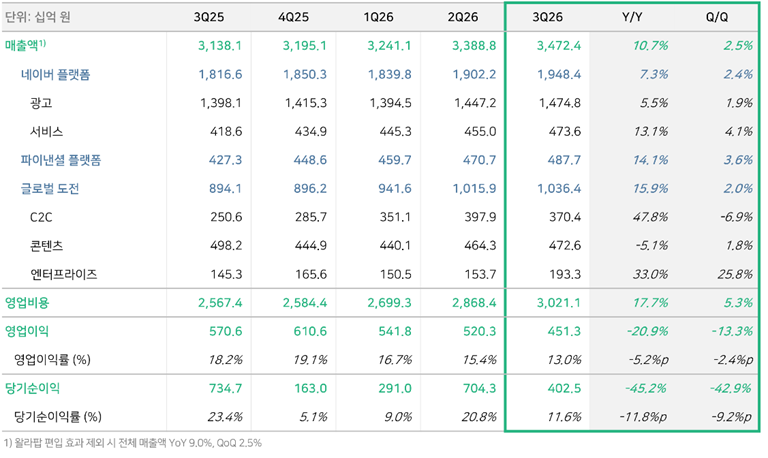
NAVER Corp. (CEO Choi Soo-yeon, www.navercorp.com) announced that it posted revenue of KRW 3.4724 trillion and operating profit of KRW 451.3 billion in the third quarter of 2026.
Consolidated operating revenue for the third quarter rose 10.7 percent year over year to KRW 3.4724 trillion, driven by balanced growth across key business areas, including commerce, financial platform, and global consumer-to-consumer (C2C). Consolidated operating profit came to KRW 451.3 billion, down 20.9 percent from a year earlier, on increased investment in infrastructure, content, offline data, and other areas to secure AI competitiveness.
By business segment, revenue was KRW 1.9484 trillion for NAVER Platform, KRW 487.7 billion for Financial Platform, and KRW 1.0364 trillion for Global Initiatives.
Despite the Chuseok holiday, NAVER Platform revenue rose 7.3 percent from a year earlier and 2.4 percent from the previous quarter to KRW 1.9484 trillion, backed by advertising revenue growth from expanded AI monetization efforts and by increased purchases centered on the NAVER Plus Store app and NAVER Plus Membership. Service revenue in particular showed solid growth, up 13.1 percent year over year, as the commerce ecosystem continued to expand on the back of a larger NAVER Plus Store and membership user base and a strengthened N Delivery.
To further accelerate this growth in commerce, NAVER is moving to establish a logistics subsidiary.
“To take our delivery competitiveness to the next level, we will establish a subsidiary specializing in logistics and strengthen our delivery infrastructure, built around leased logistics centers, in phases,” said Choi Soo-yeon, NAVER CEO. “Through a virtuous cycle in which delivery competitiveness drives more transactions and the added volume in turn raises efficiency, we will build a commerce ecosystem where sellers, users, and partners grow together.”
Financial Platform revenue totaled KRW 487.7 billion, up 14.1 percent year over year and 3.6 percent quarter over quarter. Npay payment volume for the third quarter rose 15.6 percent from a year earlier to KRW 26.2 trillion, driven in part by 21.8 percent year-over-year growth in external payment volume. Notably, with the rollout of Npay Connect, an integrated offline terminal, proceeding smoothly, the Npay payment ecosystem spanning online and offline is expected to expand further as the connection and synergy between offline stores and NAVER services strengthen.
By the first half of next year, NAVER Financial plans to become the No. 1 operator in Korea’s integrated offline terminal market in terms of active terminals.
The Global Initiatives segment recorded revenue of KRW 1.0364 trillion, up 15.9 percent year over year and 2.0 percent from the previous quarter. The increase came from higher C2C revenue, driven by the effect of Wallapop’s consolidation and brisk transactions on Poshmark and SODA, together with steady growth in enterprise revenue, including from the digital twin project in Saudi Arabia.
Starting in the first half of next year, revenue related to the AI factory business that NAVER is pursuing with Brookfield and NVIDIA will be reflected in its results in earnest.
“As we have secured initial customers by signing computing service supply contracts worth approximately KRW 2 trillion for the AI factory business, revenue from the business is also set to be generated progressively,” Choi said. “While pursuing mid- to long-term contracts with large customers, we plan to expand our customer base to global AI companies with high growth potential and achieve not only stability but also high profitability.”
Meanwhile, NAVER is also actively seeking new revenue opportunities by advancing its AI-based services. Following AI Briefing and AI Tab, the company plans to unveil an AI agent app by year-end and create a new service experience that goes beyond simply making recommendations and providing information and leads users to actual purchases and visits.
“The personal AI agent will offer a new user experience that goes beyond requiring users to find the information they need themselves. It will take care of necessary tasks ahead of time or handle cumbersome work on their behalf,” Choi stressed. “With this, we will continue the evolution of existing search while also gaining a new user base and creating monetization opportunities.” (End)
[Table] NAVER’s third-quarter 2026 results