





NAVER Becomes the First Korean Internet Platform Company to Implement HTTP/3
NAVER Becomes the First Korean Internet Platform Company to Implement HTTP/3
More Stable Search Service Enabled in Low Network Areas
NAVER Becomes the First Korean Internet Platform Company to Implement HTTP/3
- NAVER aims to provide a faster and more stable search service for users with the 3rd major version of the Hypertext Transfer Protocol
- HTTP/3 was confirmed to improve speed by 29% compared to HTTP/2 when tested in a slow network environment
- Capable of providing stable search results in low network areas such as 3G, elevator, and overseas
November 15, 2022
NAVER Corporation (KRX: 035420) announced on the 15th that it will become the first Korean platform company to implement HTTP/3 on its search service.
HTTP/3 is the third-generation standard protocol for exchanging data between app/browser and the web. The Internet Engineering Task Force (IETF) proposed HTTP/3 as the next-generation standard for web communication protocol last June, a change that has been made for the first time in 7 years since HTTP/2 was published in 2015. At that time, NAVER was the first Korean platform company to implement HTTP/2 in 2015.
With the implementation of HTTP/3, NAVER’s search engine is expected to provide faster and more stable search services. HTTP/3 reduces the initial connection time between the browser and web server, which ultimately shortens the total amount of time required for web page data to reach the end user. This means the search page will be displayed more smoothly on the NAVER mobile app/web or PC browser with HTTP/3.
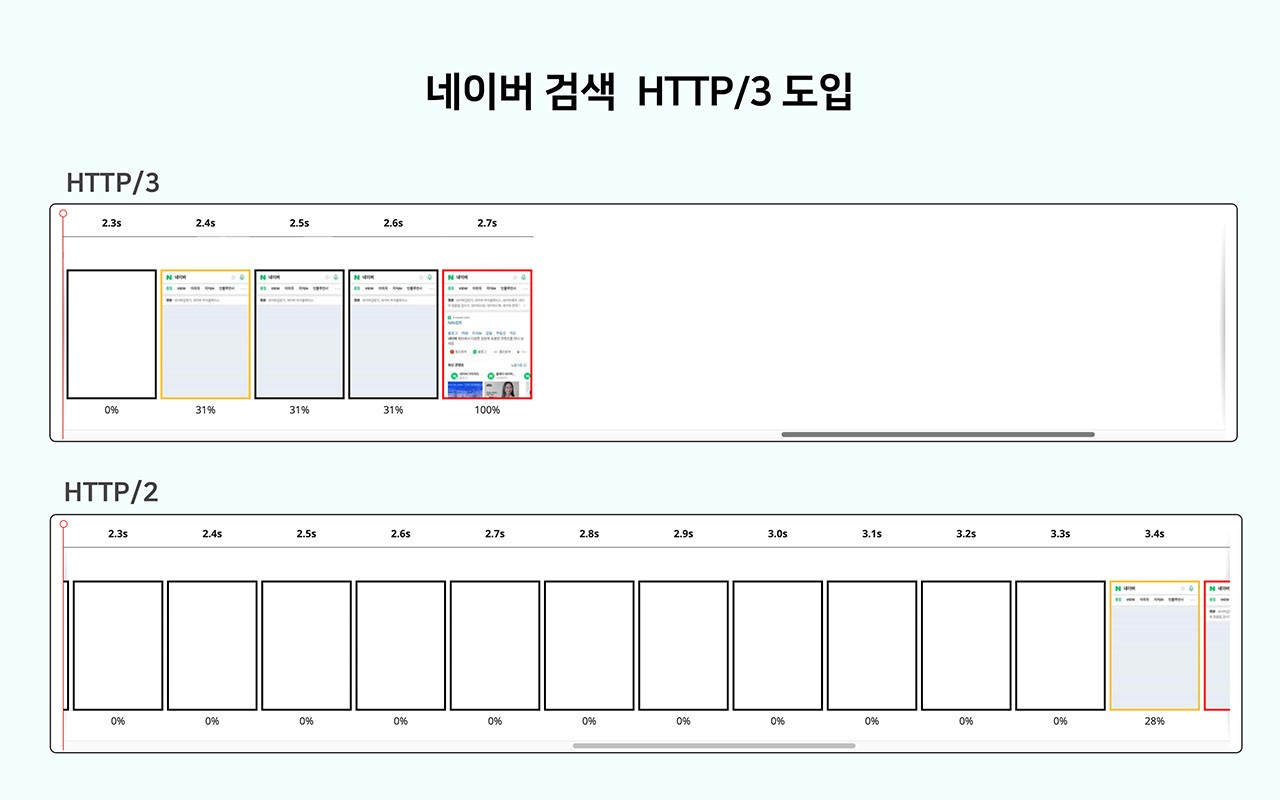
[Image] Test conducted on the comparison between the speed of the search result on the NAVER mobile app with HTTP/3 and HTTP/2 in 3G network
As a result of testing HTTP/3 implementation in a relatively slow (3G) network environment, the initial data arrival time was reduced from 2.3 seconds to 1.8 seconds, with the initial time of the search result being displayed on the web page being reduced from 3.4 seconds to 2.4 seconds. The required time was reduced by approximately 23% and 29% respectively.
In particular, HTTP/3 displays search results in a more stable manner in low network areas or areas with relatively weak signals compared to HTTP/2. For instance, HTTP/3 can smoothly display search results to users even in areas with an unstable mobile network, such as an elevator or a tunnel. The difference is much more evident in a 3G network with high network latency or an overseas environment. While HTTP/2 requires 2 to 3 additional traffic from the initial connection request to the transmission, HTTP/3 is capable of transferring data at the same time as the connection.
HTTP/3 is currently implemented on NAVER search on a trial basis for a small group of users. It will be implemented for all users after the beta test by the end of this year.
Kim Jae-hun, an executive director at NAVER Search CIC, said “HTTP/3 is already becoming the global norm, with global platform companies quickly implementing HTTP/3 to their services. As NAVER has become the first company in Korea to implement HTTP/3, we plan to take the lead in providing differentiated user convenience in our search services.”