





NAVER Publishes Double-Digit Papers at World-Renowned AI Conference NeurIPS 2022
NAVER Publishes Double-Digit Papers at World-Renowned AI Conference NeurIPS 2022
NAVER Publishes Double-Digit Papers at World-Renowned AI Conference NeurIPS 2022
- With NAVER’s CLOVA publishing 8 papers and NAVER LABS Europe publishing 3, NAVER demonstrates its cutting-edge AI R&D capabilities
- As a platinum sponsor of the conference, NAVER’s integrated booth aims to promote talent exchange and technology branding
December 5, 2022
NAVER published double-digit papers at the world-renowned AI conference “NeurIPS 2022” (Conference on Neural Information Processing Systems). Held in New Orleans, NeurIPS is the world’s largest machine learning conference with a highly selective reputation, as demonstrated by its acceptance of only the top 25% of submitted papers.
At NeurIPS this year, NAVER presented 11 research papers (8 by NAVER’s CLOVA and 3 by NAVER LABS Europe), showing its global achievement in AI research. In addition to NeurIPS, NAVER also proved its AI technologies’ position as no. 1 in Asia by publishing double-digit papers at some of the most prestigious conferences in machine learning and computer vision, including the International Conference on Learning Representations (ICLR), the Computer Vision and Pattern Recognition Conference (CVPR) and the European Conference on Computer Vision (ECCV).
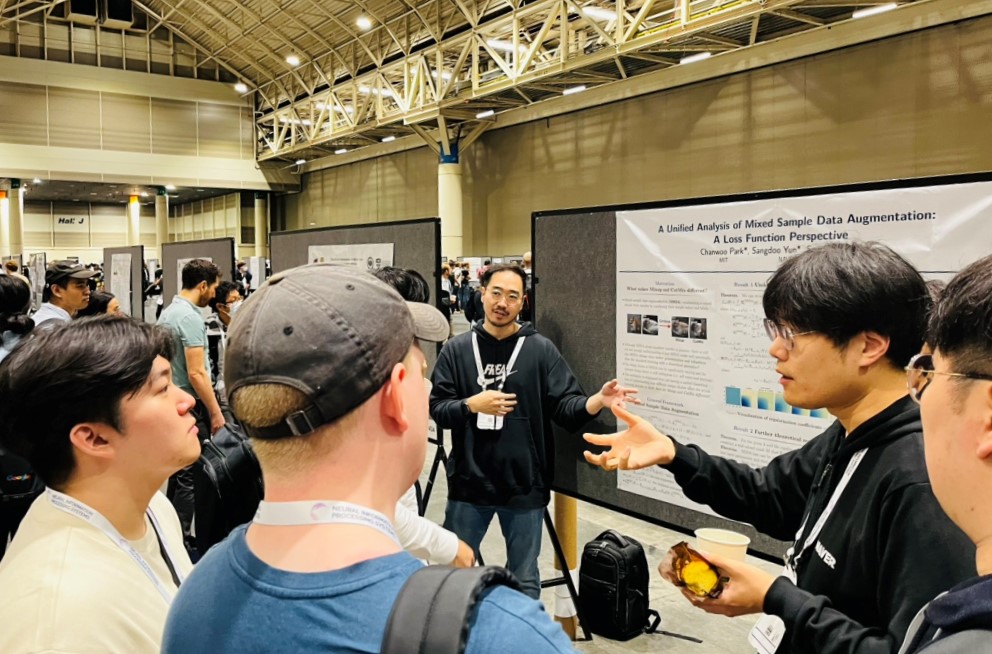
In particular, following the recent rapid development of text-to-image multimodal generative technology, NAVER gained attention by presenting a *unified metric that can effectively evaluate the quality of the generated image’s match with the input text. This technology also proves helpful in evaluating the text description of given images or robot actions based on text commands. Lastly, NAVER also analyzed **data augmentation techniques commonly used to improve image recognition models and proposed more effective techniques like “Hmix” and “Gmix.”
*Mutual Information Divergence: A Unified Metric for Multimodal Generative Models (Jin-Hwa Kim, Yunji Kim, Jiyoung Lee, Kang Min Yoo, Sang-Woo Lee)
**A Unified Analysis of Mixed Sample Data Augmentation: A Loss Function Perspective (Chanwoo Park, Sangdoo Yun, Sanghyuk Chun)
NAVER’s joint research with Seoul National University and the Korea Advanced Institute of Science and Technology (KAIST) also resulted in significant findings, wherein NAVER led research efforts on data augmentation techniques to reduce bias in AI models with SNU, data generation techniques through learning data compression with KAIST, and, in addition, collaborated with Korea University on speech synthesis. NAVER announced its plan to build research institutes with SNU and KAIST in May 2021, and has continued to collaborate closely in hyper-scale and hyper-creative AI since then.
*SelecMix: Debiased Learning by Contradicting-pair Sampling (Inwoo Hwang, Sangjun Lee, Yunhyeok Kwak, Seong Joon Oh, Damien Teney, Jin-Hwa Kim, Byoung-Tak Zhang)
**On Divergence Measures for Bayesian Pseudocoresets (Balhae Kim, Jungwon Choi, Seanie Lee, Yoonho Lee, Jung-Woo Ha, Juho Lee)
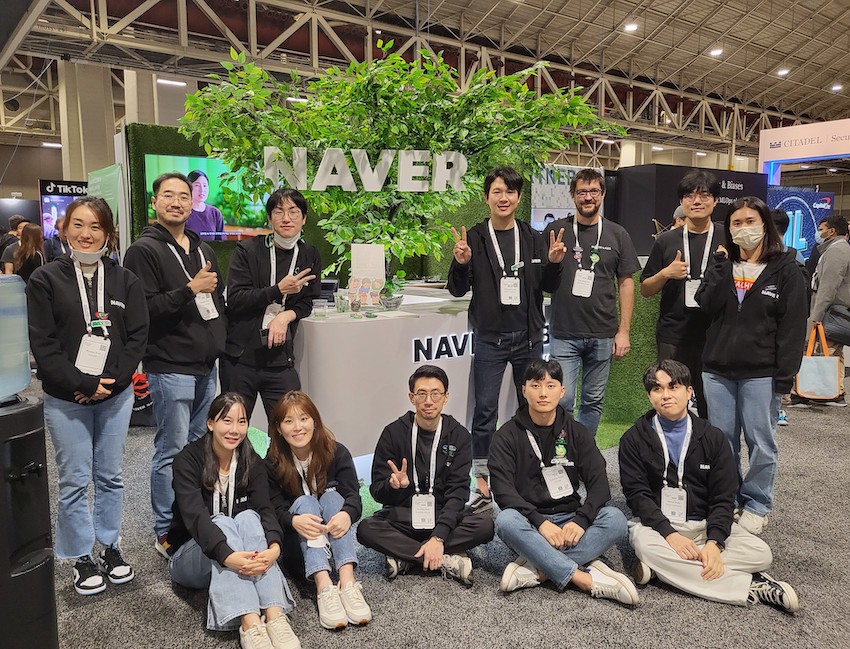
As a platinum sponsor of NeurIPS, NAVER set up an integrated booth to promote global technology branding and AI talent exchange. While more than 10,000 AI researchers from around the world attended the conference, many researchers and company representatives also visited NAVER’s booth and showed interest. There, NAVER held the “NAVER Night” event to showcase its latest technologies and interact with AI researchers, and supported the “K-pop in NeurIPS” event for participants interested in K-pop.
According to Ha Jung-Woo, head of NAVER AI Lab and the Social Chair of the NeurIPS Organizing Committee, “By consistently investing in AI research and partnering with reputable research institutions in Korea and overseas, NAVER's AI R&D skills are increasingly recognized worldwide. Our objective is to create novel and advanced services for our users by utilizing state-of-the-art technologies, and focus on advancing AI capabilities that are essential to NAVER's businesses and services through the research and development of future technologies.”
-END-