




Adding AI to the Search Experience: NAVER AI TAB Service Brief
Adding AI to the Search Experience: NAVER AI TAB Service Brief
In June 2026, NAVER launched “AI Tab,” a new service that combines generative AI technology with the search assets NAVER has built up over many years.
AI Tab goes beyond simply providing search results. It tailors its answers to each user’s question by bringing together the rich information that is updated in real time across NAVER, from restaurant reservation availability to authentic product reviews.
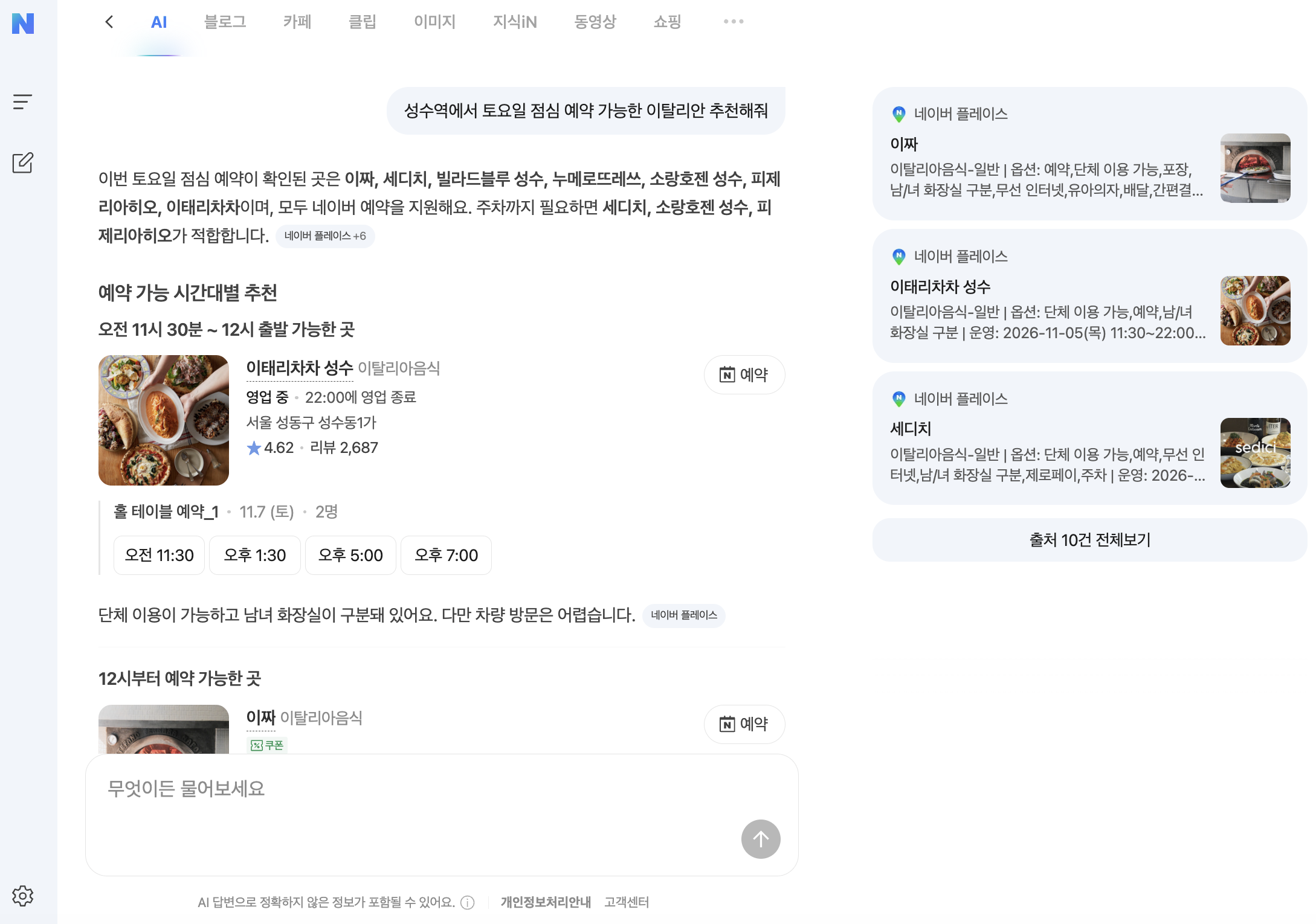
Example of the AI Tab service screen
How are users actually using AI Tab, and what changes are emerging in the way people search? Together with a research team led by Professor Kim Kyung-oe of Yonsei University, NAVER published the “NAVER AI Tab Service Brief,” an in-depth look at how AI Tab is being used, based on real service data. Below are the key findings.
AI Tab supports better decisions based on real experiences.
For questions without a single right answer, such as parenting concerns, the questions and reviews of people who have been through similar experiences become an important reference. AI Tab builds its answers from this kind of experience-based information accumulated across NAVER Cafe, Blog, and Jisik-iN. In other words, it brings together into a single answer the posts that NAVER users used to search for and compare on their own. It also cites its sources, so users can visit the original posts to explore more examples.
In fact, after reading AI Tab’s answers, users tended to move on to the NAVER services cited as sources, such as Cafe or Blog. They naturally continued exploring by checking the experience-based information behind the answer for themselves.
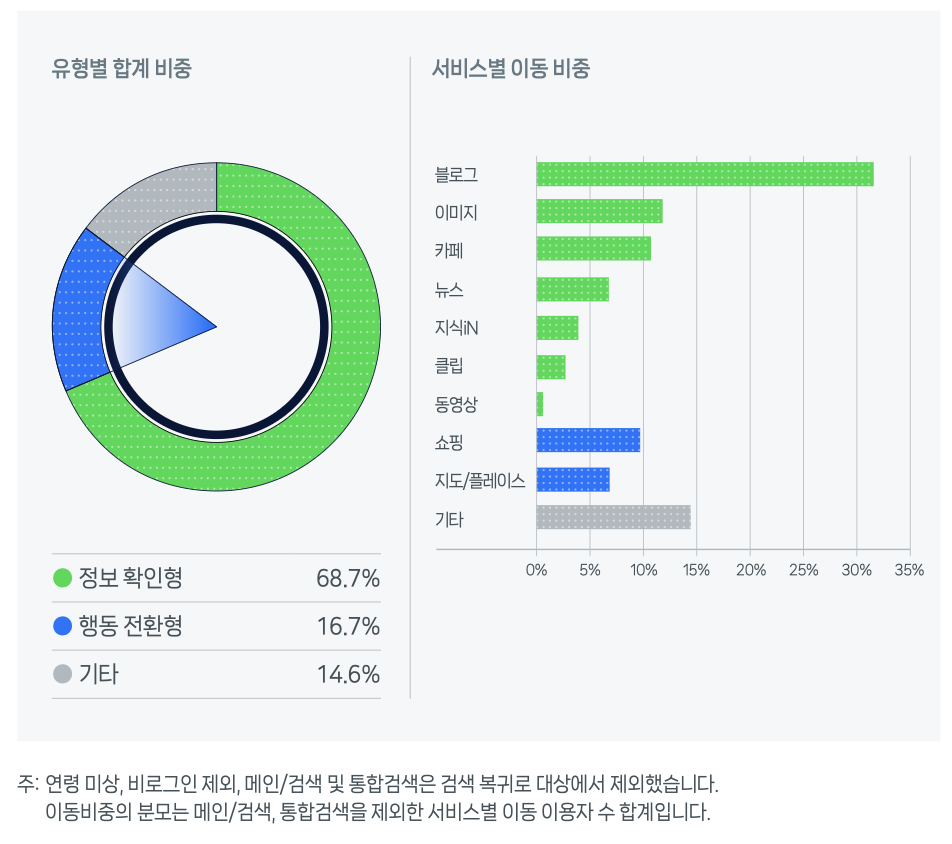
Share of services users visited after AI Tab
AI Tab connects information search to real-world action.
When generating an answer, AI Tab draws on the NAVER service that best fits the question. If a user asks about a product, it calls on NAVER Shopping; if they ask about a place, it calls on NAVER Map/Place, and reflects those results in its answer.
According to NAVER’s internal survey, more than half of AI Tab users said that seeing an AI answer led them to actually make a purchase, book a reservation, or visit a place. Real service data showed the same trend, with click-through rates for NAVER Shopping and Map/Place within AI Tab each exceeding 40%.
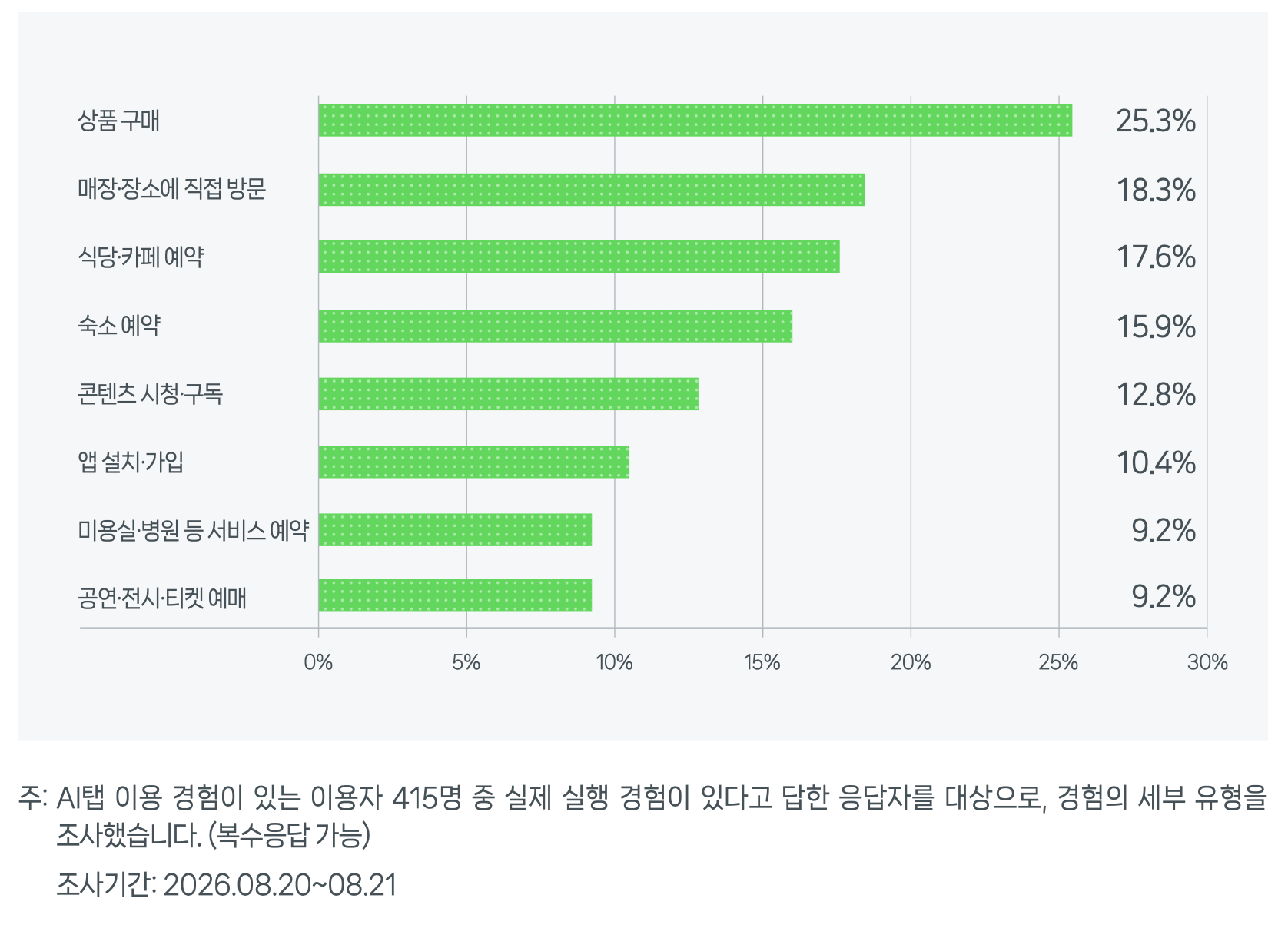
Breakdown of real-world actions following AI Tab
Mini Interview with the Research Team
We spoke with Professor Kim Kyung-oe of Yonsei University, who led this research, about the changes AI Tab has brought and what lies ahead.
Q. Do you use AI Tab yourself? What has your experience been like?
A. I had been using it even before starting the research, and I felt that finding information had become much easier. In the past, I had to open search results one by one and organize them myself. AI Tab summarizes the key points first, so I could choose to look only at what I needed. Consistent with our data analysis, I also find AI Tab especially useful in everyday moments, like looking for places to visit or comparing products.
Q. Based on the search behaviors identified in this analysis, how do you see search changing in the AI era?
A. The biggest change is that search is becoming more like a conversation. In the past, people typed in short keywords and went through the results one by one. Now, they ask questions in full sentences and follow up based on the answers to get closer to the information they want.
Our analysis of AI Tab confirmed this shift. Users in their teens and twenties showed a relatively high share of multi-turn usage, exchanging several questions with the AI. Users in other age groups showed different behaviors, such as checking the sources of the information AI provided or verifying it through additional searches.
What I find notable is that AI is not simply replacing traditional search, but changing the very way users explore and use information. Rather than accepting AI answers as they are, users treat them as a starting point to explore and compare further, and then turn that into actual choices and actions. Ultimately, I believe the role of search is expanding from finding information to supporting users’ decision-making.
Q. What do you think sets AI Tab apart from other AI services?
A. In my view, AI Tab’s greatest strength is its ability to connect users’ information search to real action. Usually, before buying a product or visiting a place, people need to weigh many kinds of information. They need qualitative information (“soft information”) such as other people’s experiences, reviews, and ratings, but they also need concrete information (“hard information”) such as price, location, business hours, and reservation availability.
NAVER has not only years of accumulated content on Blog and Cafe, but also a wide range of services such as Shopping, Map, and Reservation. This means AI Tab can provide both the qualitative information users need to make judgments and the concrete information they need to act, and then connect that to actions like purchases and reservations. With typical generative AI services, the answer itself is often the final output, and users have to move to another service to buy or book something. AI Tab, by contrast, connects multiple services within the answer, so everything from searching for information to taking action can happen in one seamless flow. Our analysis also showed users exploring further after reading AI answers and going on to make actual purchases and reservations.
Going forward, I think it will become increasingly difficult for services to stand out simply by providing accurate and useful search results or answers. In the end, competitiveness in the search market will depend not just on how well a service provides information, but on how effectively it helps users turn that information into real decisions and actions. In this respect, I believe NAVER AI Tab, which can organically connect rich content with diverse services, has a significant competitive edge.
Q. What do you hope to see from AI Tab in the future?
A. I hope AI Tab evolves beyond a service that simply answers questions accurately, into one that helps users achieve their goals more easily and efficiently. In many cases, the ultimate purpose of searching for information is not to get an answer itself, but to use that information to make a judgment or take action. So it’s important to understand users’ context and goals, organize the information they need, and naturally connect it to their actual choices and actions. In that sense, if AI Tab develops into a service that narrows the gap between searching for information and taking action, I expect it will deliver even greater value to users.
Search that doesn’t stop at finding information, but continues all the way to choice and action. Through this service brief, we confirmed that users are using AI Tab as part of how they make everyday decisions. Building on the experience-based information and diverse services that users have created together with us over many years, NAVER will continue to develop AI Tab so it can better understand each user’s goals and help them take real action.
✨ For more details, please see the link below:
