





NAVER CareCall Social Value Measurement
NAVER CareCall Social Value Measurement
CLOVA CareCall (hereinafter "CareCall") is NAVER's generative AI-based phone call service. The service is designed to conduct natural, context-appropriate conversations with care recipients using natural language processing technology. Through this, it regularly checks the health status, meal status, sleep patterns, and emotional state of recipients, and can detect early warning signs. It also identifies high-risk individuals early and connects them with welfare and health services to support integrated care, contributing to the prevention and mitigation of social risks such as suicide and solitary death.
Since its pilot launch in May 2022, CareCall has been supporting local governments’ care services in regions across the country, including Seoul, Gyeonggi, Daegu, Incheon, Busan, and Ulsan. The social legitimacy of AI-based services introduced in the public sector can be more clearly confirmed by quantitative verification of the actual social benefits generated by technological innovation. This report aims to analyze the effects of CareCall's introduction from the perspective of social cost savings and risk mitigation, converting these into monetary value to calculate the social value (SV) created by CareCall. This study was conducted as a follow-up to the "Digital Economy Report 2025," published last October, to confirm the economic value and social contribution of NAVER services.
This study employed two parallel analytical frameworks to measure and verify the social value(SV) of CareCall.
PART I is a micro-level analysis based on a survey of institutions that adopted CareCall, directly measuring effects in detailed categories such as increased administrative efficiency, increased preventive healthcare use, and reduced emotional isolation. PART I analysis results show that CareCall’s SV estimated for survey-responding institutions was approximately KRW 14.4 billion, and when extrapolated based on total CareCall usage (actual connected and answered calls), it amounts to approximately KRW 34 billion. Suicide and solitary death prevention accounted for the largest share, and significant value was also confirmed in the emergency/health domain, including referral and linkage to support services for patients with serious illness, dementia, and those requiring follow-up support
PART II is a macro-level analysis estimating policy effects at the population level by comparing CareCall-adopting and non-adopting regions using public data at the city/county/district and city/province level. PART II analysis found that the increase in solitary death rates among individuals aged 60 and over was smaller in CareCall-adopting regions (▼44.2%), and a shift toward preventive healthcare use was observed, including a decrease in emergency room visits (▼9.2%) and an increase in hospital visits (▲1.5%). When converted to economic value, this amounts to approximately KRW 840 million in SV. Furthermore, estimating the potential value under a service expansion scenario, if CareCall is introduced nationwide and 20% of the population aged 60 and over uses it, approximately KRW 417.2 billion in SV could be generated.
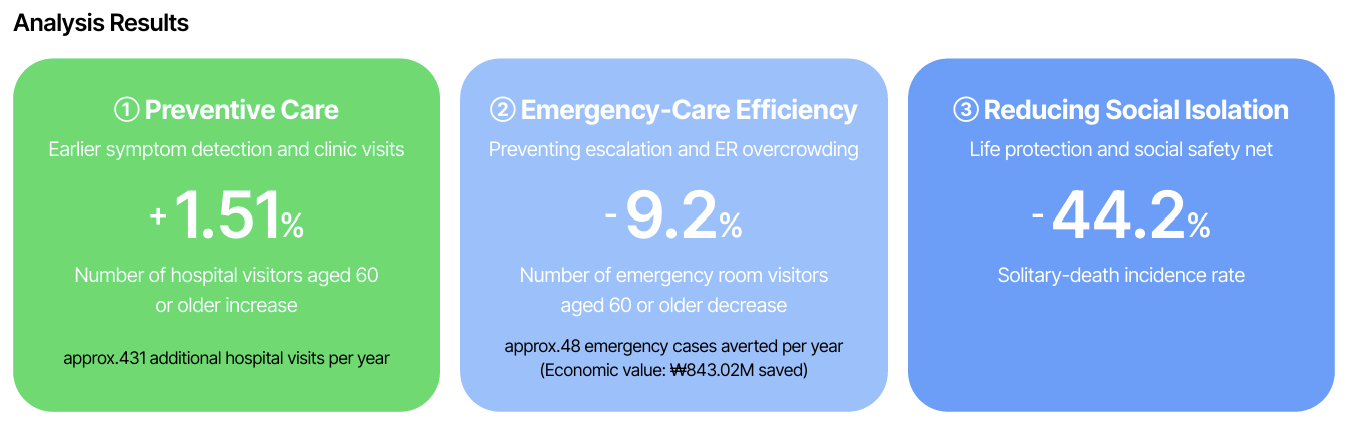
While PART I and PART II differ methodologically, they are complementary in that they respectively confirm the effects of CareCall in actual service operations and at the community level. Taken together, the two analyses show that CareCall's introduction simultaneously creates multi-layered effects, including expanding preventive healthcare use, improving the appropriateness of emergency medical care use, and alleviating social isolation. These results demonstrate that CareCall can function as a policy tool that goes beyond simple cost reduction—raising the qualitative level of the public safety net and strengthening a prevention-oriented welfare system. The future regional expansion of the service and the phased broadening of its target population are expected to contribute to enhancing the effectiveness of social welfare policy and further solidifying the digital-based public safety net.
Prof. Hoyoung Lee and Prof. Youngsok Bang of the Yonsei University research team that conducted this study commented, "This study is meaningful in that, by quantifying the various benefits — including social-wide cost savings and risk mitigation — created by AI-based public services, it establishes a foundation for quantitatively evaluating the social value of the service." They added, "It can also serve as an objective basis to support financial and policy decision-making in future discussions of service expansion or policy institutionalization."
