





NAVER CEO Choi Soo-yeon: “The True Tipping Point for Industrial AI Will Come When Even Small Businesses Can Easily Use AI”
NAVER CEO Choi Soo-yeon: “The True Tipping Point for Industrial AI Will Come When Even Small Businesses Can Easily Use AI”
Talk at the 19th Asia-Pacific Conference of German Business (APK) 2026
NAVER CEO Choi Soo-yeon: “The True Tipping Point for Industrial AI Will Come When Even Small Businesses Can Easily Use AI”
- CEO Choi Soo-yeon holds a special talk on industrial AI with Siemens Chairman Roland Busch at APK 2026
- The foundation for AI use should be broadened to small and medium-sized enterprises and partner companies to raise productivity and competitiveness across the industrial ecosystem
- Siemens Group executives visit NAVER 1784 and discuss ways to cooperate on technology for AI transformation at industrial sites
November 2, 2026
NAVER (CEO Choi Soo-yeon) announced on November 2 that Choi held a talk on industrial artificial intelligence (AI) with Siemens Group Chairman Roland Busch at the 19th Asia-Pacific Conference of German Business (APK), which took place at the Grand InterContinental Seoul Parnas on October 31.
First held in 1986, the APK is a business event co-hosted by the Korean-German Chamber of Commerce and Industry (KGCCI) and the German Federal Ministry for Economic Affairs and Energy (BMWE), among others. It brings together government officials from the Asia-Pacific region and global business leaders to discuss avenues for industrial cooperation.
As AI expands into the physical world in fields such as manufacturing, energy, and mobility, the talk was organized as a core program of APK 2026 to explore the potential for global cooperation in advancing industrial AI, building on the technological strengths of Germany and Asia.
“The true tipping point for AI in industrial settings will come when even small businesses can easily use AI,” said Choi during the talk. “Only when the foundation for AI use extends to small and medium-sized enterprises and partner companies can the gains of individual companies translate into higher productivity and competitiveness for the industry as a whole,” she emphasized.
“As the range of work AI performs widens, the role of people who verify its results and make judgments becomes even more important,” Choi continued. “The tangible outcomes of AI adoption lie not only in the quality of what AI produces but also in whether it has solved real problems in the field and the extent to which the time and resources saved through AI have been put toward more valuable work,” she added.
The two also exchanged views on how to drive innovation in industrial operations by combining Germany’s industrial engineering expertise with Asia’s capabilities in semiconductors, AI models, and digital platforms.
“Industrial AI has reached an important turning point for realizing new possibilities,” said Busch. “The value of industrial AI comes to fruition only when it is implemented safely and reliably on site and spreads across industry as a whole.” He went on to say, “By combining Germany’s long-standing engineering expertise with Asia’s fast-growing capabilities in technological innovation, the two regions will usher in a new industrial era together.”
Following the talk, Busch visited NAVER 1784 with key executives, including Dagmar Mundani, Head of Mergers & Acquisitions; Chung HaJoong, CEO of Siemens Korea; and Stefanie Frank, Head of the Digital Industries Division at Siemens Korea.
Executives from both companies, including NAVER CEO Choi Soo-yeon, NAVER LABS CEO Seok Sang-ok, and Siemens Chairman Roland Busch, shared examples of NAVER’s digital twin technology being applied at actual industrial sites, and discussed ways to cooperate on expanding it into global markets in conjunction with Siemens’ industrial solutions. They also explored potential collaboration on next-generation technologies under research and development at NAVER, such as robotics and robot foundation models. Afterward, they toured the 1784 building and saw NAVER’s advanced technologies operating in a real-world environment.
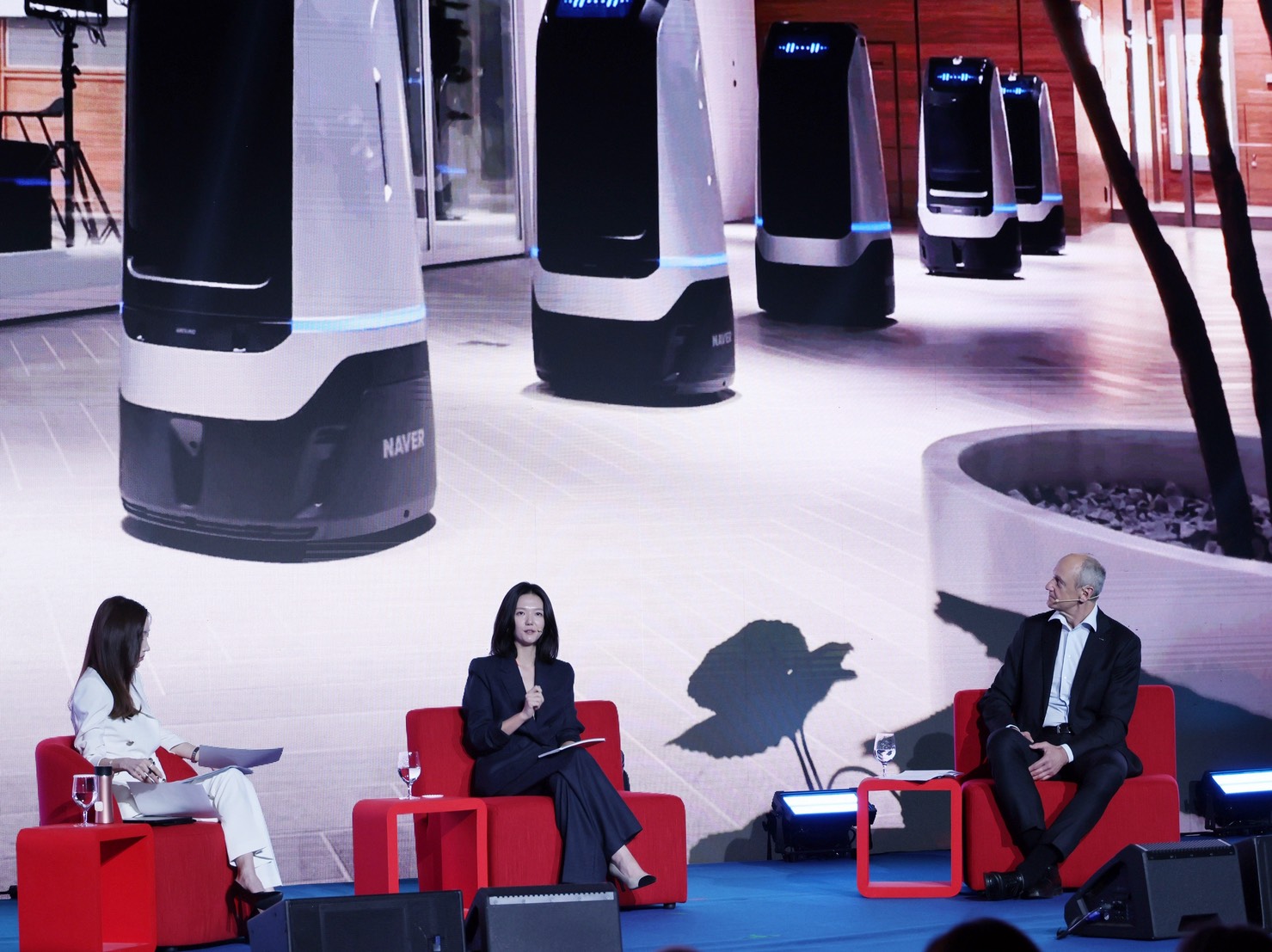
CEO Choi Soo-yeon (center) holds a talk on industrial artificial intelligence with Siemens Group Chairman Roland Busch (right) at the 19th Asia-Pacific Conference of German Business, held at the Grand InterContinental Seoul Parnas on October 31.
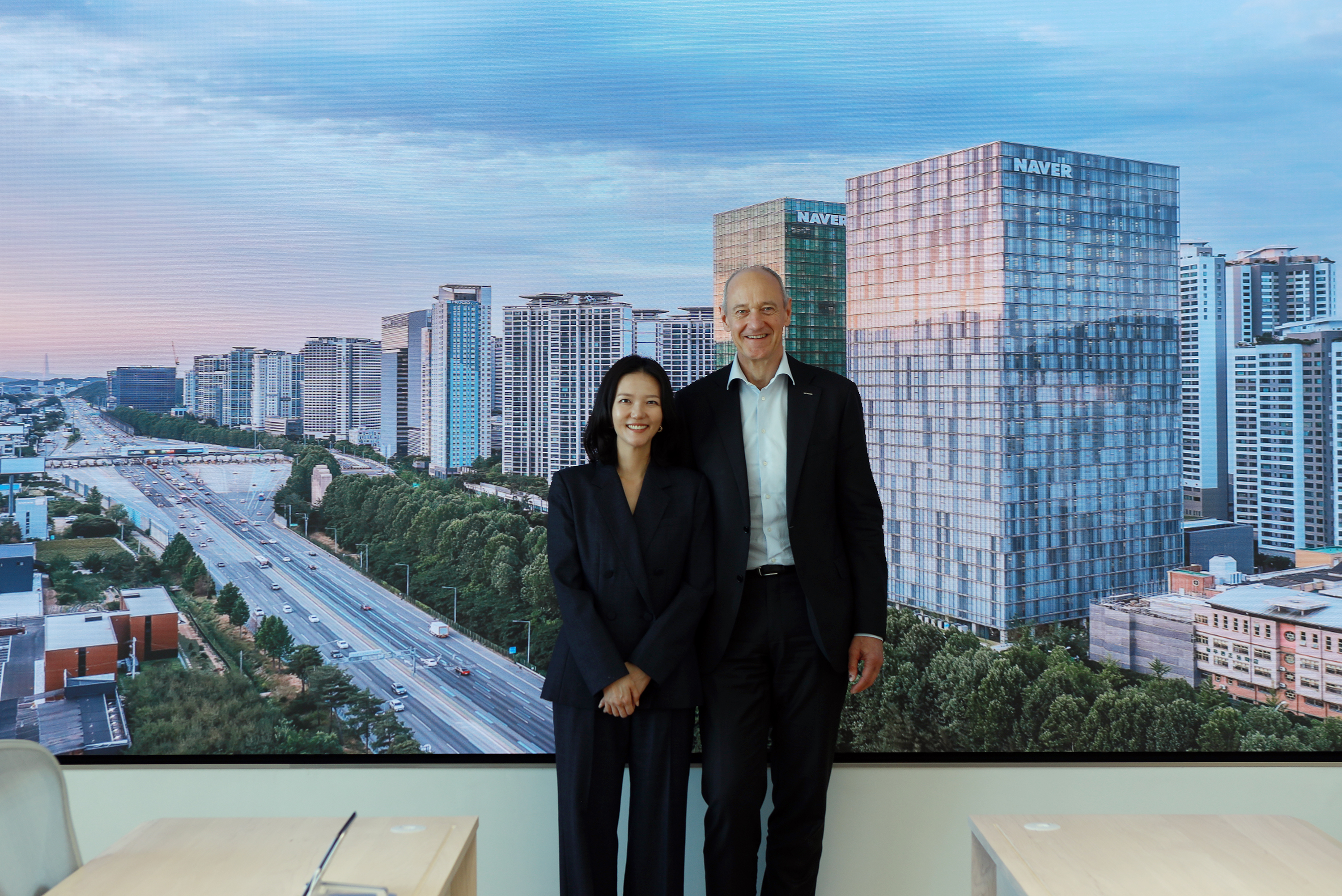
Siemens Group Chairman Roland Busch (right) and NAVER CEO Choi Soo-yeon (left) pose for a commemorative photo after meeting at NAVER 1784 on October 31 and discussing ways the two companies can cooperate on technology.
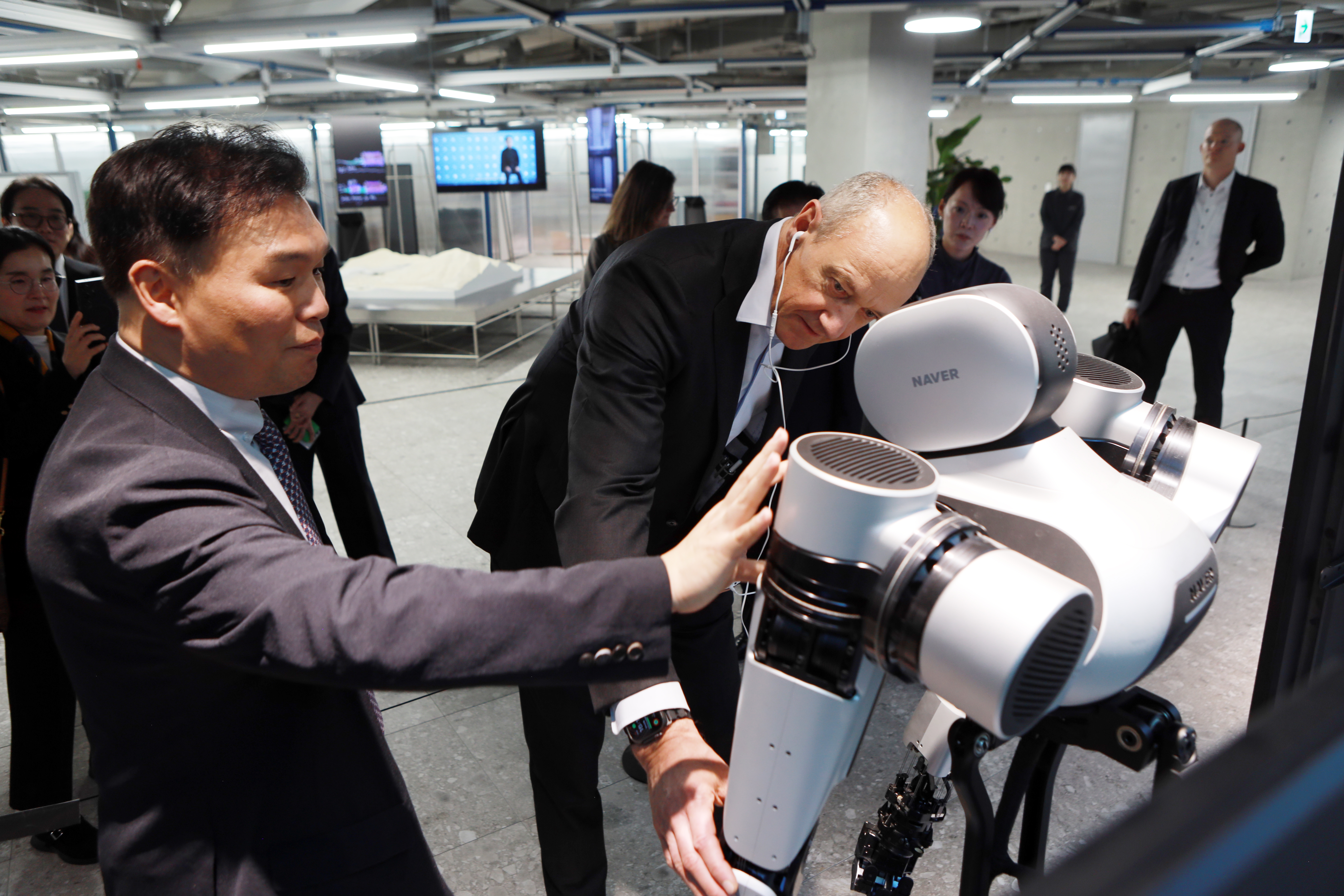
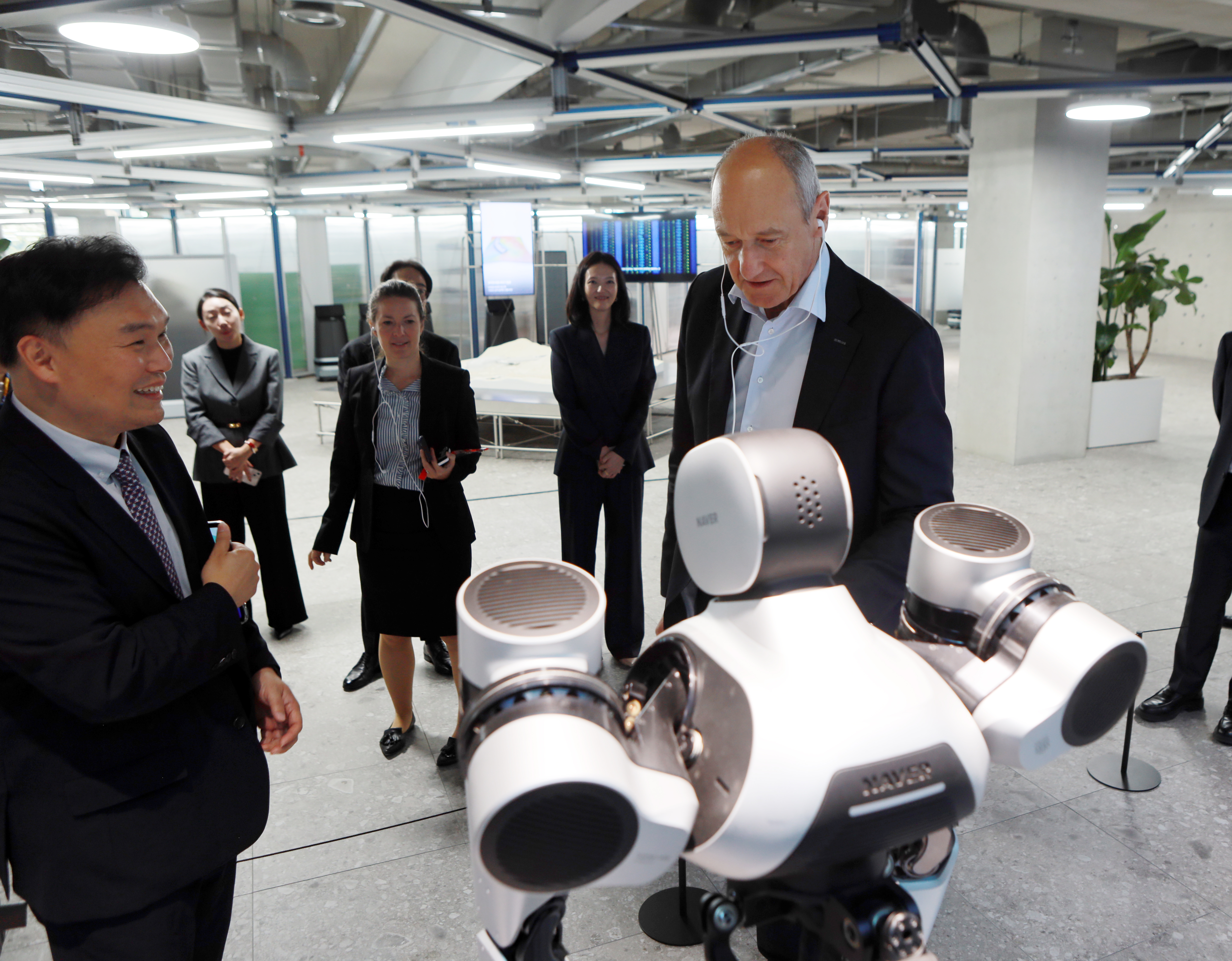
NAVER LABS CEO Seok Sang-ok (left) explains NAVER’s robotics and other technologies to Siemens Group Chairman Roland Busch, who visited NAVER 1784 on October 31.
