





NAVER Cloud Sets Out to Build “Combat-Ready AI Logistics” with Republic of Korea Army Logistics Command
NAVER Cloud Sets Out to Build “Combat-Ready AI Logistics” with Republic of Korea Army Logistics Command
NAVER Cloud Sets Out to Build “Combat-Ready AI Logistics” with Republic of Korea Army Logistics Command
- Joint pilot of AI services for direct use in the logistics field, covering a procurement platform, condition-based maintenance, and digital twin logistics
- Logistics-specific cloud and support from engineers embedded in the field to set up a framework for the military to use AI on its own
November 2, 2026
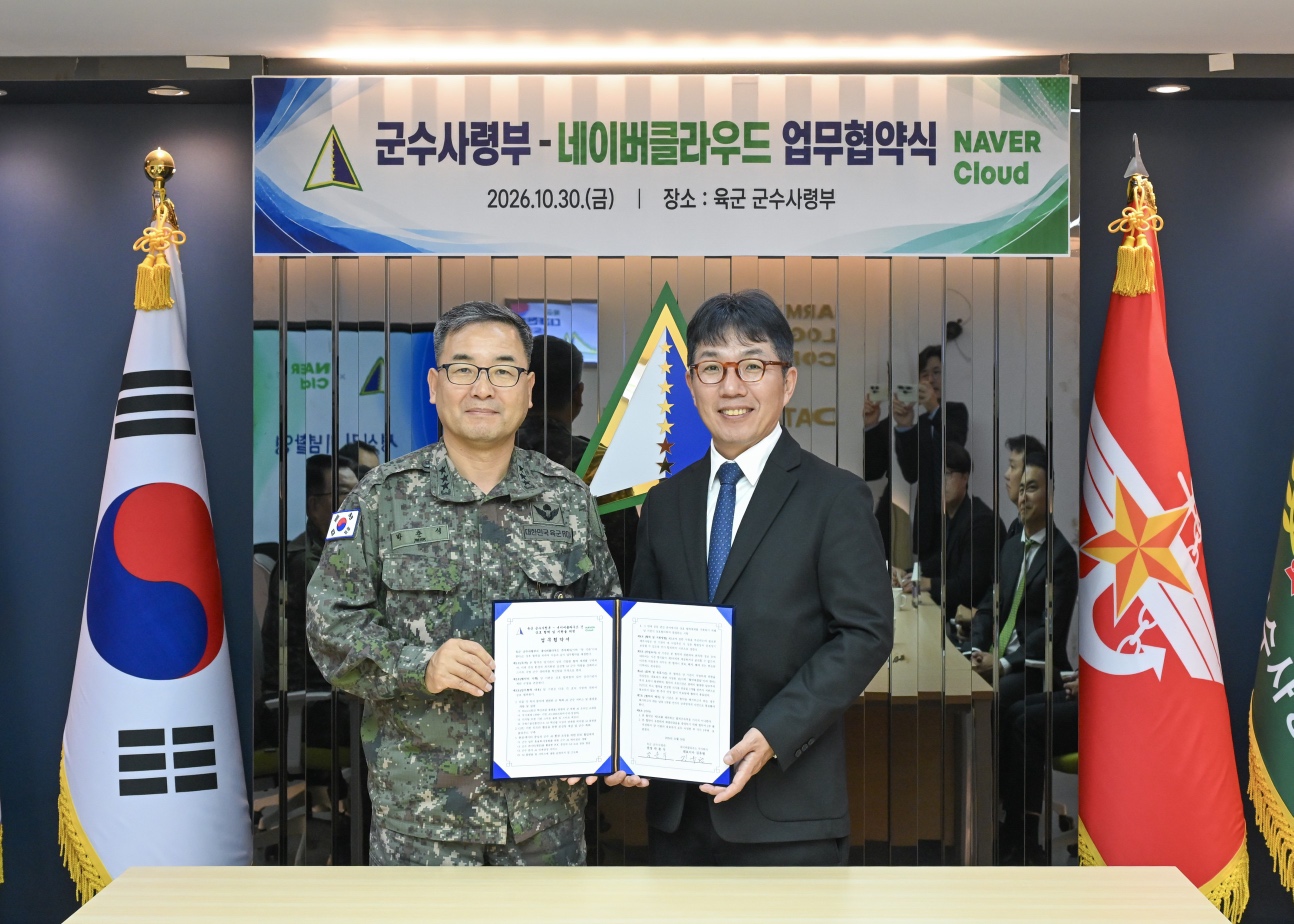
[Photo] NAVER Cloud signed an “Agreement on Optimizing for the Future Battlefield Environment and Strengthening Combat-Ready AI Logistics Capabilities” with the Republic of Korea Army Logistics Command. (From left) Park Choon-sik, Commander of the Army Logistics Command, and Kim Yu-won, CEO of NAVER Cloud
NAVER Cloud (CEO Kim Yu-won) is teaming up with the Republic of Korea Army Logistics Command to build a “combat-ready AI logistics” system that integrates AI into all areas of military logistics, including procurement, maintenance, and distribution.
NAVER Cloud announced on November 2 that it had signed the “Agreement on Optimizing for the Future Battlefield Environment and Strengthening Combat-Ready AI Logistics Capabilities” on October 30 at the Army Logistics Command in Daejeon. The signing ceremony was attended by key officials from both organizations, including Lieutenant General Park Choon-sik, Commander of the Army Logistics Command, and Kim Yu-won, CEO of NAVER Cloud.
The Army Logistics Command oversees all aspects of Army logistics, including supply, maintenance, and transportation. On the future battlefield, where new weapon systems such as manned-unmanned teaming systems and drones are rapidly proliferating, transforming the logistics that support them into intelligent systems driven by data and AI is emerging as a key task.
The agreement is significant in that it marks a starting point for NAVER Cloud to validate the AI and cloud capabilities it has built in the defense sector through real-world military logistics operations and to expand them into the military’s AI transformation (AX) ecosystem.
First, the two organizations will jointly develop and pilot AI services that can be put to use right away in the logistics field. These include a procurement platform tailored to the military that sources needed supplies through performance-based AI matching; condition-based maintenance plus (CBM+), which analyzes weapon system status data to perform maintenance before failures occur; and smart logistics and smart factories based on digital twins.
To back these efforts, NAVER Cloud plans to provide consulting on the use of GPU infrastructure and help build a logistics-specific cloud. Its forward-deployed engineers (FDEs) will also take part directly in the field, developing logistics AI agents that automate repetitive tasks and identifying new AI use cases based on logistics data. The company will further support AI talent development for military logistics as well as the operation and enhancement of the platform, which is expected to continuously strengthen the military’s ability to use AI.
“Military logistics is a field where vast amounts of data move in real time, from procurement to maintenance and distribution, and it is the area where AI transformation can have the greatest impact,” said Kim Yu-won, CEO of NAVER Cloud. “Together with the Army Logistics Command, we will develop a field-proven, combat-ready AI logistics model and contribute to building an AX ecosystem for the Korean military.”
Meanwhile, NAVER Cloud has been steadily expanding its cooperation in the defense sector this year, including jointly developing an AI model specialized for the defense industry with Korea Aerospace Industries (KAI) and taking part in the Joint Chiefs of Staff (JCS) AX hub project with Korea University’s C5ISRT Convergence Research Center. In September, the company hosted the “Defense AI Strategy Seminar,” attended by about 550 officials from the Ministry of National Defense, the JCS, and each branch of the armed forces. There, it presented a defense AX cooperation model in which the military has control over its data and AI models and rapidly turns private-sector technology into operational capabilities. (End)
