





NAVER Partners with University of Tübingen to Lead AI Technology R&D in Europe and Asia
NAVER Partners with University of Tübingen to Lead AI Technology R&D in Europe and Asia
NAVER Partners with University of Tübingen to Lead AI Technology R&D in Europe and Asia
- NAVER to work with the University of Tübingen in Germany, known for outstanding achievements in artificial neural network and robotics
- Partnership to research on eliminating bias and improving comprehensibility and develop trustworthy AI algorithms
- NAVER aims to become a global AI leader through partnerships with universities across the world
2021-07-01
NAVER is on its way to becoming a global leader in artificial intelligence (AI). The company announced on June 30 that it has signed a Memorandum of Understanding (MoU) with the University of Tübingen in Germany, to engage in cooperative research on fair and trustworthy AI in Europe and Asia.
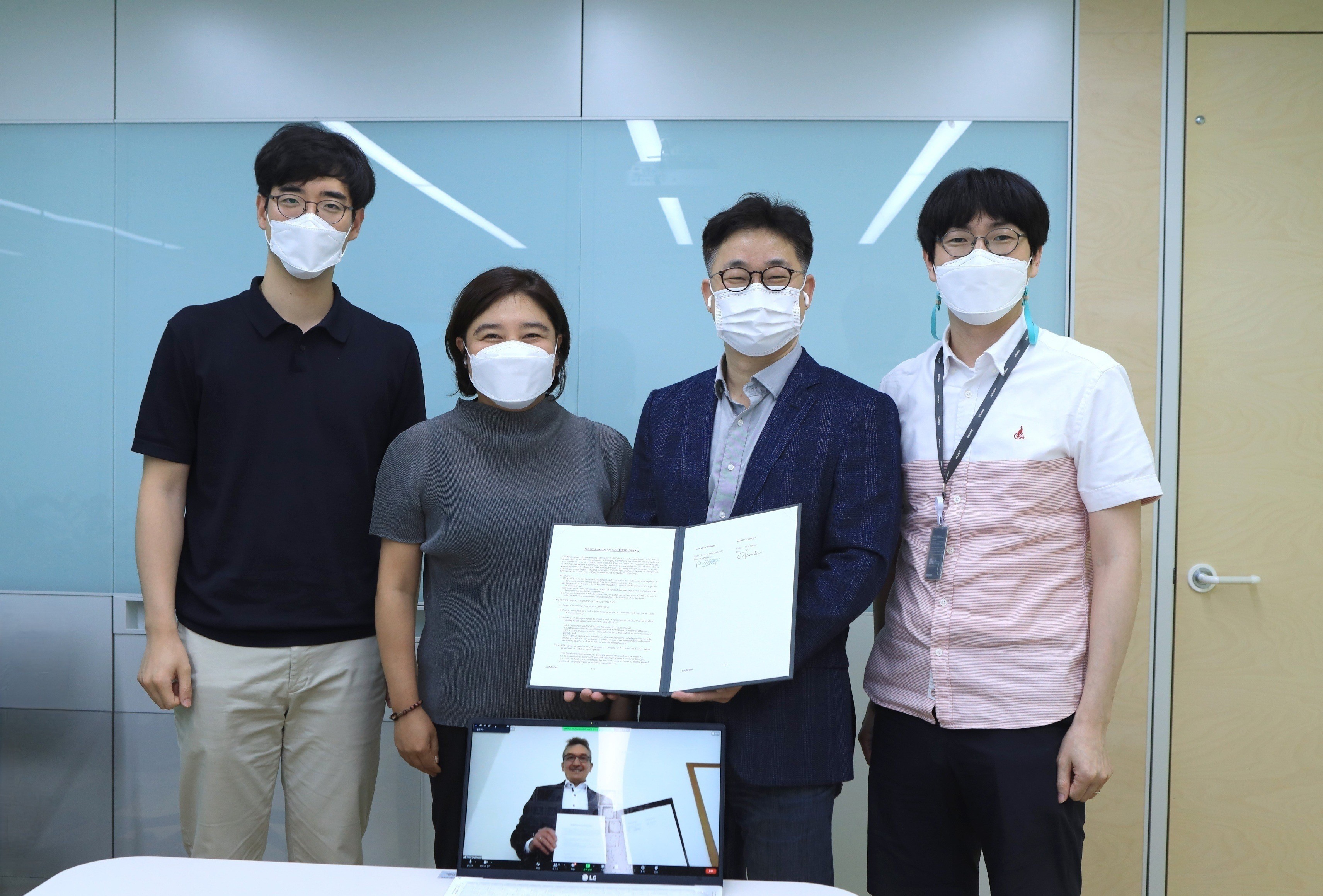
(From left) Seong-Joon Oh, Research Scientist of NAVER AI LAB; Seon-ju Chae, NAVER Chief Communication & Culture Officer; Suk-Geun Chung, Head of NAVER CLOVA CIC; Jung-Woo Ha, Head of NAVER AI LAB; and Peter Grathwohl, Co-President of the University of Tübingen
Officials from NAVER and the University of Tübingen attended the online signing ceremony, including NAVER Chief Communication & Culture Officer Seon-ju Chae, NAVER CLOVA CIC head Suk-Geun Chung, NAVER AI LAB head Jung-Woo Ha, NAVER AI LAB research scientist Seong-Joon Oh, along with University of Tübingen Co-President Peter Grathwohl, Director of the Tübingen AI Center Matthias Bethge and Professor Zeynep Akata.
Founded in 1477, the University of Tübingen (officially the Eberhard Karl University of Tübingen) is a world-renowned AI research institute. The university has shown outstanding performance in fields such as artificial neural networks, machine learning and robotics, and is also conducting joint research with big tech companies such as Amazon.
NAVER is working with the University of Tübingen to create trustworthy AI algorithms. Both parties will conduct collaborative research on how to prevent and mitigate machine learning bias. And they will work to improve AI comprehensibility so that users can easily understand how AI-based systems derive results. NAVER and the University of Tübingen stated these efforts are aimed at providing a more reliable method for users to make decisions using AI.
Furthermore, NAVER will establish a joint research institute within the Tübingen AI Center for closer R&D cooperation by the first half of 2022 and exchange knowledge with the University of Tübingen through visiting student researcher and research support programs.
NAVER’s global AI R&D network has been steadily expanding around the world. NAVER is conducting joint research with top universities, such as Seoul National University and Korea Advanced Institute of Science and Technology (KAIST), both in Korea, and Hanoi University of Science & Technology (HUST) and Posts and Telecommunications Institute of Technology (PTIT), both in Vietnam.
In addition, NAVER is studying innovative AI technologies with respected researchers from New York University, the University of Oxford and Carnegie Mellon University. NAVER Labs Europe, which is a hub of NAVER’s global AI R&D Belt, is also expanding its collaboration with leading organizations. This network will enable NAVER to become a global AI leader, comparable to IT companies in the United States and China.
“One key challenge in AI is to develop trustworthy algorithms. We need to make machine decisions more comprehensible so we can trust them,” said Matthias Bethge, Director of the Tübingen AI Center. “I know that NAVER is pushing in this important direction and we are planning various collaborative efforts to develop trustworthy AI.”
Suk-Geun Chung, head of NAVER CLOVA CIC, said, “NAVER continues to grow as a global technology company by actively working with leading AI research institutes from all around the world. We are making a paradigm shift in the AI field, accelerated by hyperscale AI research with Seoul National University, hypercreative AI research with KAIST Graduate School of AI and trustworthy AI research with the University of Tübingen.”
-End-